Who Is Your Marketing Actually For?
Most agents invent a fake ideal client. The best ones reverse-engineer a real one from deals they have already closed. Here is the difference, and how to find yours this week.
Try something uncomfortable. Pull up your last three social posts. Now cover your name and your headshot with your thumb.
Could those posts belong to any agent in your market?
For most of us, the honest answer is yes. Same "Just Listed." Same "Rates dropped, let's talk." Same "Happy to help with all your real estate needs." Strip the logo off and the post could have come from anyone with a license and a Canva account.
That is not a content problem. It is an aim problem. You cannot write something that lands for a specific person when you are quietly writing for everyone.
And here is the part nobody says out loud. Writing for everyone is the most comfortable mistake in this business, because it never forces you to choose. It feels safe. It is actually why good agents stay invisible.
01 / The Avatar Trap
Soccer Mom Sarah isn't real.
Open any marketing course and you will get the same assignment. Build your ideal client avatar. Give her a name. Soccer Mom Sarah. She is 38, drives a Highlander, drinks oat milk lattes, has 2.4 kids and a golden retriever.
It feels productive. You fill out the worksheet, you feel organized, and then you go right back to posting for everyone.
The avatar fails for one reason. You made her up.
There is no commission check behind Sarah. No closing. No 2am text. She is a character you invented to feel strategic, and your gut knows it, which is why she never actually changes a single word you write.
Everyone is not your customer.
Seth GodinMost agents nod at that and then keep marketing like everyone is. There is a better way, and it does not require imagination. It requires memory.
02 / The Reframe
Don't invent. Reverse-engineer.
Here is the shift. You do not need to dream up your ideal client. You have already met them. They are sitting in your closed files.
Somewhere in your transaction history are the deals that felt easy. The clients you actually liked. The ones who paid you fairly, did not melt down at inspection, sent you their sister three months later, and made you remember why you got into this. The clients you would clone twenty times if you could.
That is not a fantasy persona. That is data. Real names, real triggers, real reasons they chose you, backed by money that already cleared.
Alex Hormozi built a large part of his playbook on exactly this move. Look at the customers you already love, find what they have in common, and build everything around that pattern. He points out that it feels almost too obvious, which is precisely why so few people do it.
The legends of our own industry teach the same thing from a different door. Tom Ferry, ranked among the top real estate coaches in the country for years, builds his entire system on knowing your ideal client and then reverse-engineering where they are and what they need. Brian Buffini built an empire on a single stubborn idea: your best business does not come from cold strangers, it comes from your best relationships. Both are pointing at the same gold mine. It is behind you, not in front of you.
The aim of marketing is to know and understand the customer so well the product or service fits him and sells itself.
Peter DruckerYou cannot know a customer you invented. You can know one you have already closed.
03 / The Exercise
Mine five deals, not your imagination.
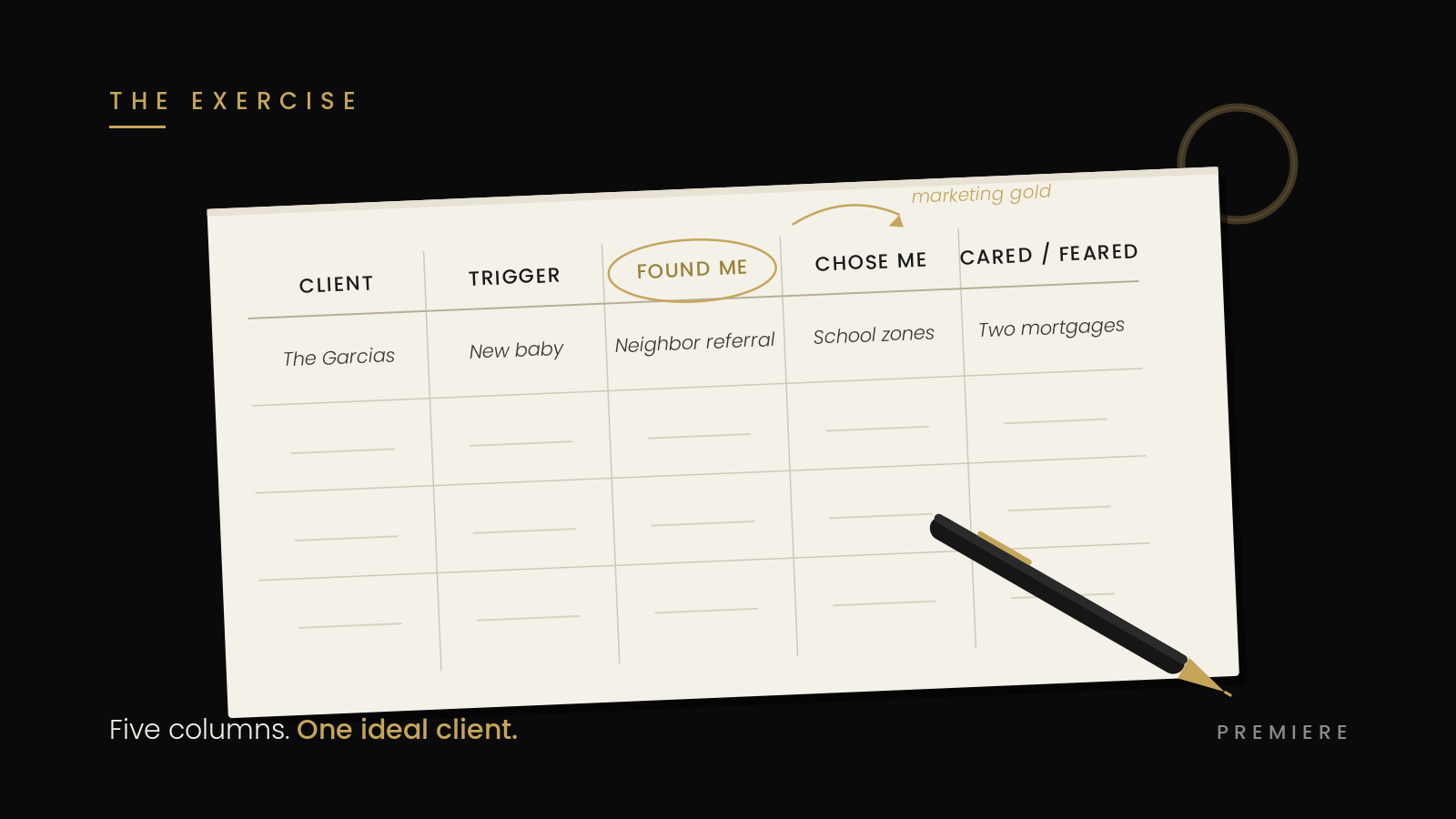
This takes about twenty minutes and a piece of scratch paper. Turn it sideways. Write it by hand. You think differently when you are not formatting.
Step one. Pick your five best clients. Not your five biggest checks. Best.
This distinction matters more than anything else here. The biggest commission you ever earned might have come from your worst client. Paid you well, made you miserable, never referred you, and you would not do it again for double. That is not a client to clone.
Best means most profitable for the effort. Lowest stress. Most referrals. The ones you genuinely liked. Run the clone test on each one: if you could copy this exact person twenty times, would your business be both more profitable and more enjoyable? If yes, they make the list.
Newer agent without five closings? Use the five people in your life you would most love to do a deal for. Your sister, your old coworker, your gym friend. You know them cold. That is real data too.
Step two. Build a five-column grid. One row per client. Columns: Client, Trigger, Found Me, Chose Me, Cared or Feared.
Step three. Fill it in, one column at a time.
Trigger. What life event actually put them in the market? Divorce, new baby, job relocation, first home, empty nest. Not "they wanted to buy." The thing that genuinely pushed them off the fence.
Found Me. How did they really find you? Which referral, which platform, which event. Circle this column. This one is marketing gold, because it tells you exactly where to show up.
Chose Me. Why you over the other agent they could have called? What did they say when they signed?
Cared or Feared. What mattered most to them, and what was the worry keeping them up at 2am?
04 / The One Sentence
Distill it down to a single line.
Now look down your columns and circle the patterns. Which trigger shows up most? Which "Found Me" repeats? Which fear keeps reappearing?
Then write one sentence:
My ideal client is a ______ who values ______ and finds agents through ______.
Kill the demographics on your way. "A 35-year-old woman" tells you nothing you can use. Watch the difference:
"My ideal client is anyone buying or selling in the metro."
"My ideal client is a young family outgrowing their starter home, scared of carrying two mortgages, who values an agent that knows the school zones cold and finds agents through neighborhood Facebook groups."
The first sentence is a census. The second one is a marketing plan. It tells you what to post, what fear to speak to, and exactly which channel to live on.
One gut check. If your sentence could describe half the people in your city, it is still too broad. Add the trigger. Add the fear. Add where they actually come from. You are not writing a demographic. You are writing a person you could picture across the table.
05 / The Proof
For the part of you that needs permission.
If this still feels like it narrows your business too much, look at the numbers.
McKinsey found that 71 percent of consumers now expect personalized, relevant communication, and 76 percent get frustrated when they do not get it. Generic does not just fail to attract. It actively annoys the person you wanted.
The same research found that the fastest-growing companies pull roughly 40 percent more of their revenue from personalization than everyone else. Specificity is not a branding nicety. It is where the growth lives.
And in our world specifically, the National Association of Realtors found that 40 percent of buyers found their agent through a friend, neighbor, or relative, rising to 51 percent for first-time buyers. For sellers, 66 percent came through a referral or a repeat relationship. Those people can only refer you well if they know exactly who you are for. "She helps people buy and sell houses" does not travel. "She is the one empty-nesters call when they are ready to let go of the big house" gets repeated at the dinner table.
Specific is not the risk. Generic is.
06 / The Fear
Niching down is not turning business away.
The objection underneath all of this is always the same. "If I niche down, I am turning away business."
You are not.
This is about who your marketing speaks to, not who you are allowed to work with. You still take the deal when it comes. You still answer the phone. Narrowing your message does not turn away a check. It just stops you from sounding like every other agent in the feed, which means the right people finally feel like you are talking to them.
You are not shrinking your business. You are sharpening the magnet.
07 / The Through-Line
It belongs everywhere you show up.
Your ideal client is not a setting you adjust on one Instagram caption and forget. It is the filter for every word you put out. Same person, every channel. Your bio. Your Google profile. Your follow-up texts. Your open house talk track. Your voicemail. When the profile is right, all of it starts to sound like it was written for one human being instead of a market.
So before you draft your next post, do not ask what to say.
Ask who it is for.
You already know the answer. You closed it last year.
Published by PREMIERE, the number one mega team at REAL Brokerage, operating across NC, VA, AZ, CO, GA, CA, TX, TN, and FL. We share what is actually working in agent marketing. No gatekeeping.
Check out this article next